
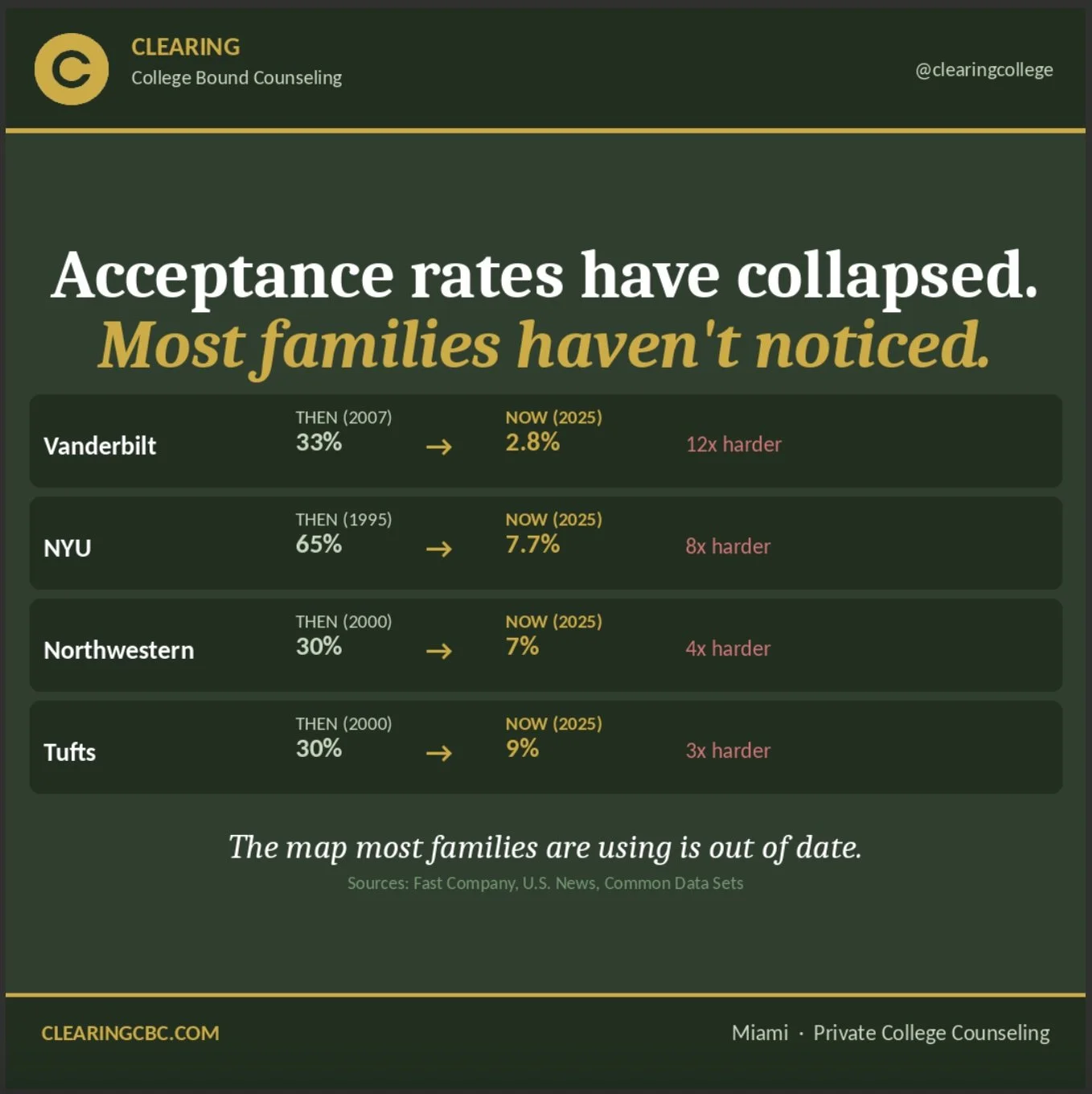
Acceptance Rates Have Collapsed. Most Families Haven't Noticed.
There is a number most families do not know, and it is one of the most important numbers in the college process right now.
Vanderbilt University accepted 33% of applicants in 2007. Today that number is 2.8%, from a pool of nearly 49,000 students. NYU admitted 65% of applicants in 1995. Today it is 7.7%. Northwestern and Tufts, schools that once accepted more than 30% of students, now admit fewer than 10%. Duke, Brown, Dartmouth, Bowdoin, and Williams are posting record-low acceptance rates. The schools that defined "ambitious but reachable" for a generation of families have moved to a different category entirely.
And most families are still working from the old map.
What Actually Happened
The number of students applying to college has risen 30% since 2020. The number of applications submitted has increased 55%. The graduating Class of 2025 is projected to be the largest in American history, at nearly 3.9 million high school seniors. Colleges are not expanding their freshman classes to match this demand. They are simply choosing from larger pools, which means acceptance rates fall year after year at the schools that were already selective.
The Common Application made it easy to apply to 15 or 20 schools with minimal additional effort. Many strong students now do exactly that. The result is that highly selective schools are flooded with well-qualified applicants, most of whom will be rejected regardless of their credentials.
At the same time, more than 2,000 colleges across the country accept the majority of students who apply. Some are now using direct admissions, where students are accepted simply by entering basic information into the Common Application. Access to a college education is not disappearing. What is disappearing is the middle ground, the schools that once felt like solid targets for a student with a 3.8 GPA and a strong profile. Many of those schools have shifted into a different tier entirely.
What This Means for Your Student
The families I work with are not trying to get into Harvard. They are trying to make a good decision about a strong school that fits their student. The challenge is that the schools in the middle of the selectivity range have gotten dramatically harder to get into, and many families are building their college lists based on acceptance rates from five or ten years ago.
A school that admitted 25% of applicants a decade ago might admit 12% today. That is not a minor adjustment. That is a different calculation entirely, and it changes which schools belong in the target, reach, and safety categories for a given student.
None of this is a reason for panic. It is a reason for preparation. The students who navigate this environment well are the ones with genuinely balanced college lists built on current data, not outdated assumptions. They are the ones who understand how to use Early Decision and Early Action strategically. They are the ones whose applications are specific and coherent rather than generic. And they are the ones whose families started the conversation early enough to make real decisions rather than rushed ones.
The landscape has shifted. What worked for the class that graduated five or ten years ago is not a reliable guide for the class that is applying now. Understanding where things actually stand is the starting point for everything else.
That is the conversation I help families have at Clearing.