
How to Build a College List That Actually Works
Most families approach the college list the same way they approach a wish list. They write down schools they have heard of, schools their friends' children attended, schools with recognizable names. Then they add a couple of schools that feel safe and call it balanced.
That is not a college list. That is a collection of names. And it tends to produce a senior year full of anxiety, surprises, and decisions made under pressure rather than with clarity.
A college list that actually works is built on three things: honest data, a clear-eyed assessment of a specific student's profile, and a genuine understanding of what each school on the list offers that student. Here is how to do it.
Start with an honest academic profile
Before you put a single school on the list, you need to know where the student stands. That means GPA, the strength of the curriculum, and standardized test scores if the student is submitting them. It also means understanding how these numbers compare to the middle 50% of admitted students at each school you are considering, not the average, which can be misleading, but the range from the 25th to the 75th percentile.
A student whose numbers fall comfortably above the 75th percentile is likely to be admitted. A student whose numbers fall below the 25th percentile faces real difficulty regardless of other strengths. This is not the whole picture, but it is the foundation of every honest list.
Build genuine categories
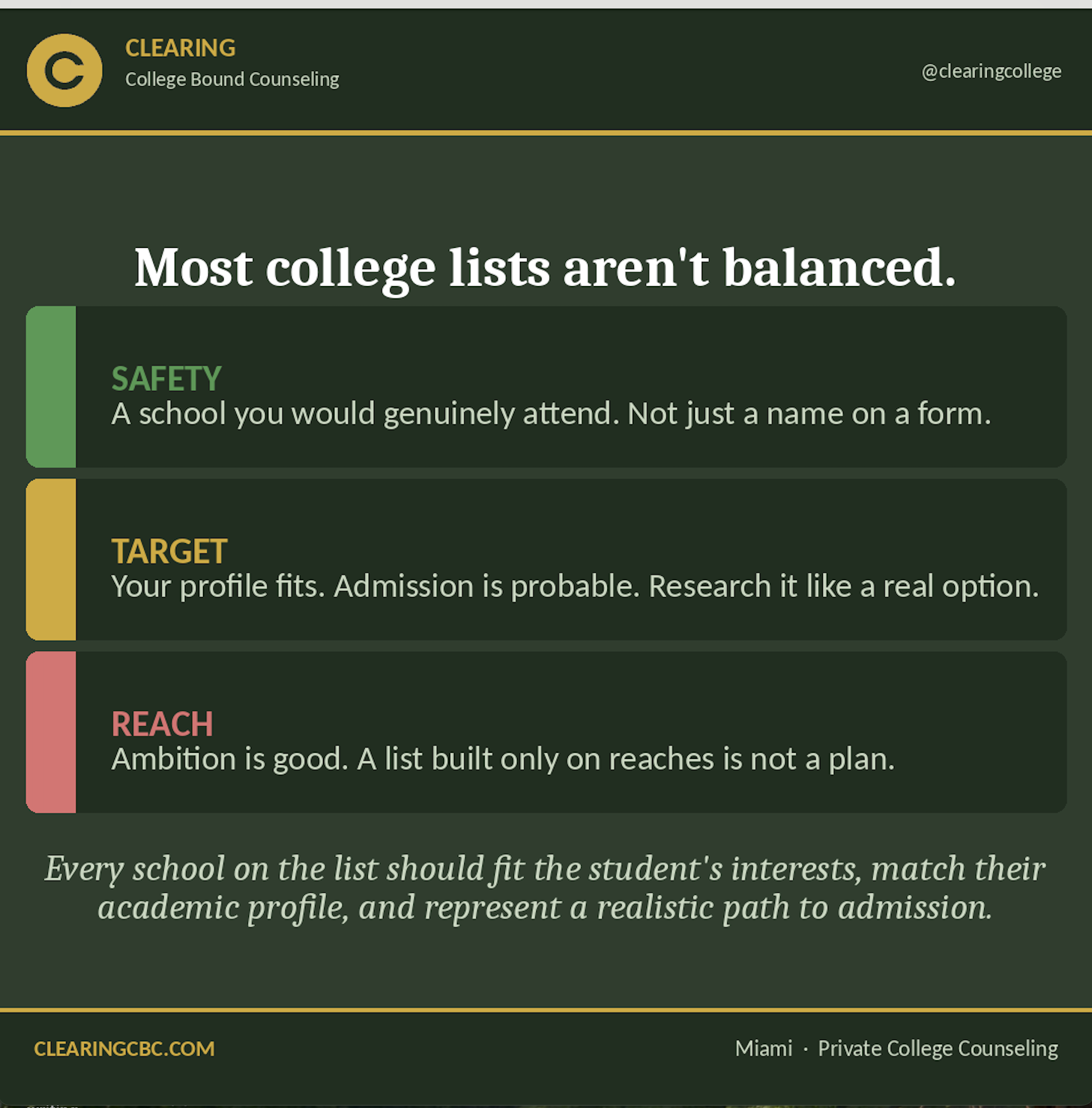
A balanced list has three categories. Most families know the words but misapply them.
A safety school is a school where the student is highly likely to be admitted based on their academic profile, and where the student would genuinely be happy to attend. That second part matters as much as the first. A school that a student refuses to consider attending is not a safety. It is a placeholder. Every student should have two or three genuine safeties on their list, schools they have researched, schools that fit who they are, schools they could walk into on September 1st feeling good about.
A target school is one where the student's academic profile falls solidly within the admitted range, where acceptance is probable but not guaranteed. Target schools are the center of gravity of any good list. A student with a realistic, well-matched set of target schools has options regardless of how the reaches play out.
A reach school is one where the student's numbers are below or at the lower end of the admitted range, or where the school is so selective that even highly qualified students face long odds. Reaches belong on every list. They represent ambition, and sometimes they come through. But a list built primarily on reaches is not a plan. It is a gamble.
How many schools
The right number is somewhere between ten and fifteen for most students. Fewer than ten and the list does not provide enough options. More than fifteen and the quality of each application tends to suffer. Supplemental essays take real time and thought, and a student writing thirty supplements is rarely writing any of them well.
A reasonable structure for most students is two to three safeties, five to six targets, and three to four reaches. The exact balance shifts depending on the student's profile and goals, but that structure gives a family real choices when decisions arrive in the spring.
The list changes with strategy
If a student is applying Early Decision to a school, the list adjusts. ED fills a significant portion of many schools' incoming classes, which means the remaining spots in the regular round are fewer. A student committed to an ED school still needs a complete list, but the safety and target categories become even more important as a backstop if the ED outcome is a deferral rather than an admission.
Research is not optional
Every school on the list should be there for a reason. Not because a friend mentioned it, not because it appeared on a ranking, but because the student or family has looked at it seriously. That means understanding what the school offers academically in the areas the student cares about, what the campus culture feels like, what the financial aid picture looks like, and what students who attend actually say about their experience.
A school that lands on the list without genuine research is a school that could produce a bad decision in May. The families who feel best about where their student ends up are almost always the ones who treated every school on the list as a real option, not just a name on a spreadsheet.
The list is a living document
A college list built in January of junior year should not look identical in September of senior year. Schools change. A student's profile changes. The early application strategy takes shape. Research produces surprises in both directions — schools that seemed appealing turn out not to be, and schools that seemed like afterthoughts turn out to be genuinely exciting.
Build the list early. Revisit it often. And treat it as a tool for making a good decision, not a ranking of how ambitious you are willing to be.
At Clearing, building the college list is one of the first things we do together, and one of the things we return to most often. It is the foundation of everything that follows.