
The Numbers Don't Lie: Applying Early Changes the Odds
Every year I have the same conversation with families. They have a school they love. They are reasonably well-matched to it. And they are planning to apply in January with everyone else.
I understand the instinct. January feels safer. There is more time to prepare, more time to improve a test score, more time to think. But the data tells a different story, and it is one every family in the college process should understand before they decide when to apply.
The American college admissions calendar is not neutral. When you apply matters. At many schools, it matters enormously.
What the Data Actually Shows
The numbers below are drawn from the most recent admissions cycles and reflect publicly reported institutional data. They are not outliers. They are representative of a pattern that has held for years and, if anything, is widening.
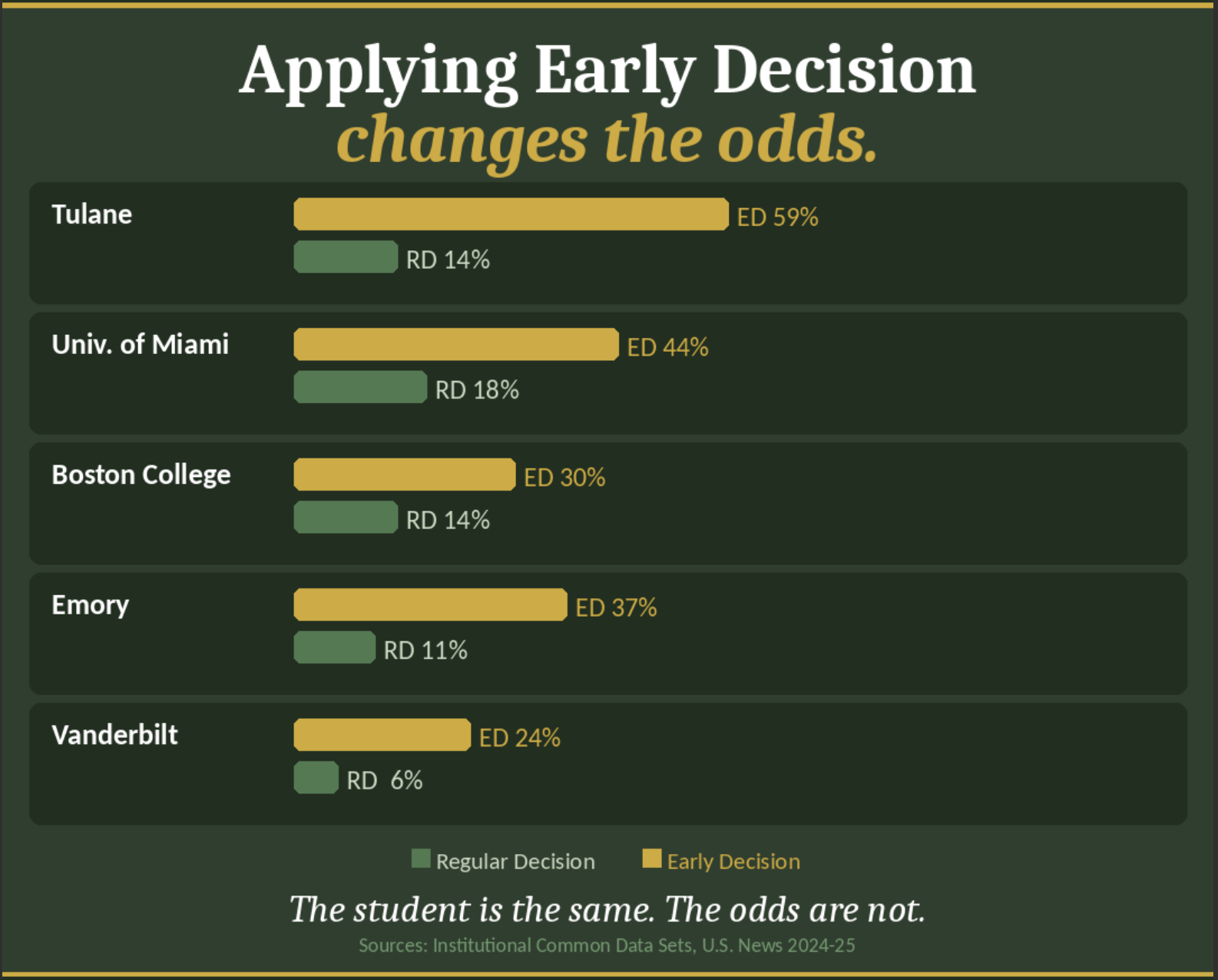
Tulane University Early Decision: 59% Regular Decision: 14% The gap: 45 percentage points. A student applying ED to Tulane is more than four times as likely to be admitted as one applying in the regular round.
University of Miami Early Decision: 44% Regular Decision: 18% UM's ED rate is more than double its overall rate. For a school that many Miami families consider seriously, this is a number worth knowing.
Boston College Early Decision: 30% Regular Decision: 14% BC admits roughly twice as many of its ED applicants as its regular decision pool, from an overall applicant base of nearly 40,000 applications.
Emory University Early Decision: 37% Regular Decision: approximately 11% Emory fills a substantial portion of its class through ED. Students who apply early are competing in a smaller, more intentional pool and are rewarded for it.
Vanderbilt University Early Decision: approximately 24% Regular Decision: approximately 6% Vanderbilt is one of the most dramatic examples in the country. Applying regular decision to Vanderbilt, for a student who knows it is their first choice, is leaving a significant advantage on the table.
Why the Gap Exists
There are two reasons the early numbers are consistently higher, and both matter.
The first is yield. Colleges care deeply about the percentage of admitted students who actually enroll. An ED admit is a guaranteed enrollment, which makes ED applicants extremely valuable to an admissions office trying to build a predictable class. Schools reward that commitment.
The second is pool quality. Students who apply early tend to be more prepared, more certain about their choice, and more engaged in the process. The early pool is smaller and more focused, which changes the competitive dynamics in ways that benefit serious applicants.
Neither of these factors is going away. If anything, as more students become aware of the early advantage and apply early, the regular decision pool at selective schools is becoming increasingly competitive for the remaining spots.
What This Means for Your Student
ED is not right for everyone. It is a binding commitment, which means it only makes sense when three conditions are met: the school is a genuine first choice, the student is academically well-matched, and the family has enough clarity on finances that committing before seeing an aid package is not a risk.
Early Action is more flexible. It is non-binding, which means a student can apply early, get an answer in December, and still compare financial aid offers before making a final decision. For schools that offer EA, there is almost no downside to using it.
The families who navigate this well are the ones who do the work early enough to make a real decision. They identify the first-choice school before the fall of senior year. They have a clear enough picture of their financial situation to know whether ED is viable. And they understand that waiting until January is not the safe choice. It is often the more difficult one.
This is exactly the kind of planning I help families do at Clearing. If your student is a junior, the time to be having this conversation is now.